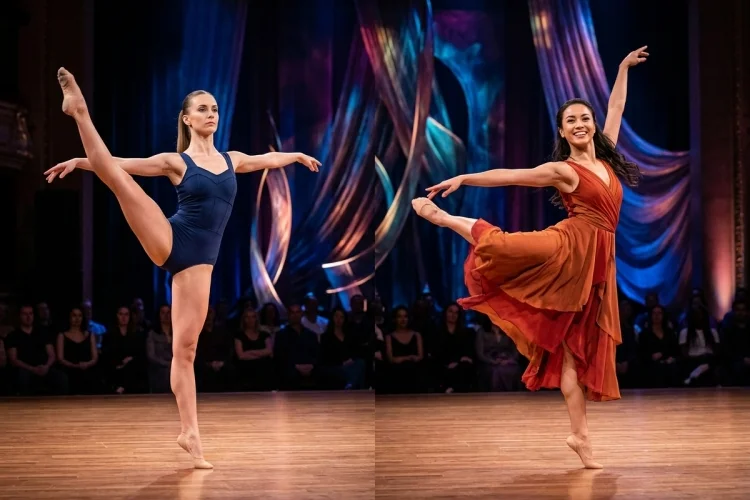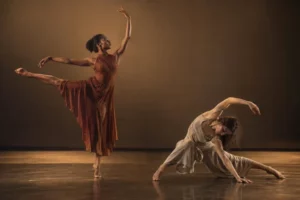
Some dance performances disappear from memory as soon as the music ends. Others stay with you for years.
You may remember a dancer’s expression, an unexpected moment of silence, a powerful group formation, or the feeling that the performers were speaking directly to you without using words.
So, what makes a dance performance memorable? It is rarely one spectacular jump or complicated turn. Technical skill matters, but audiences usually remember how a performance made them feel.
Movement, music, emotion, choreography, stage presence, and production elements must work together to create a complete experience.
Research into dance spectatorship suggests that viewers often value emotional response, connection with performers, and the physical desire to move while watching. This means a dancer does not need to perform the most difficult choreography to make an impact.
A memorable performance gives every movement a purpose. It invites the audience into its world and leaves behind an image, emotion, or question that continues after the final pose.
A Clear Artistic Intention Gives the Dance Meaning
Every strong performance needs an intention. The dancer should understand what the work is trying to express, even when the choreography does not tell a traditional story.
The intention might be an emotion, relationship, memory, social issue, or abstract idea. A dance could explore loneliness through empty space, conflict through opposing movements, or joy through fast travelling patterns.
Artistic intention helps performers make consistent choices. It influences their focus, posture, energy, timing, and relationships with other dancers.
For example, reaching toward another performer can communicate affection, desperation, curiosity, or fear. The movement itself is simple, but its meaning changes according to the dancer’s intention.
National dance standards describe artistic expression as the visible communication of artistic intent. They also recognise that the meaning of a performance emerges through movement, technique, structure, and context.
Before performing, dancers should be able to describe the purpose of the piece in one or two sentences. That clarity often makes their physical choices more convincing.
Strong Technique Makes Expression Clearer
Technique gives dancers enough control to perform movement safely, consistently, and clearly. It includes alignment, balance, coordination, strength, timing, weight transfer, and control of movement quality.
However, technical accuracy alone does not guarantee an engaging performance. A perfectly executed routine can still feel empty when the dancer appears disconnected from its meaning.
The best performers use technique as a tool rather than the final goal. They maintain alignment during a turn while still communicating emotion. They land a jump with control without interrupting the musical phrase.
The Royal Ballet School’s training system places technique alongside musicality, natural movement flow, joy, and the development of dancers as expressive artists. This reflects an important principle: skill and artistry should strengthen each other.
Beginners can apply this by choosing clarity over difficulty. A controlled walk with strong intention may be more memorable than an advanced trick performed with tension or uncertainty.
Musicality Makes Movement Feel Alive
Musicality is the ability to hear, understand, and interpret the music through movement. It involves more than staying on the main beat.
A musical dancer notices melody, rhythm, accents, lyrics, silence, texture, and changes in intensity. They may strike a pose on a sharp drumbeat, extend an arm through a long vocal note, or delay a movement to create anticipation.
Two dancers can perform the same choreography with accurate timing, yet one may appear more connected to the soundtrack. That dancer is not merely counting; they are responding to the character of the music.
Musicality also allows performers to use contrast. They do not need to move on every sound. Stillness can make an approaching accent feel stronger, while a soft gesture can make an explosive movement more surprising.
Music is also one of the external factors that professional dancers associate with peak performance experiences, alongside the work itself and the presence of an audience.
To improve musicality, dancers can rehearse the same phrase while following different layers. One repetition might follow the drums, while another responds to the melody or vocals.
Memorable Choreography Uses Repetition and Contrast
Audiences need something recognisable to hold onto. A repeated gesture, formation, rhythm, or movement phrase can become the signature of a dance.
Repetition creates familiarity, but contrast keeps the work interesting. A fast group section might be followed by a quiet solo. Large travelling movements may suddenly become small and restricted.
Changes in level, direction, speed, spacing, and energy prevent choreography from feeling flat. They also help important moments stand out.
Suppose a dancer repeatedly reaches toward the same empty corner. The first reach may look curious, the second desperate, and the third resigned. Repetition allows the audience to recognise the action, while changing its quality develops the meaning.
A strong structure is equally important. The performance should feel as though it moves somewhere rather than presenting a random collection of steps.
The National Core Arts Standards describes dance performance as an interaction between performers, production elements, and the audience that can heighten artistic expression. Choreography provides the framework that brings those parts together.
Dynamics Create Emotional Variety
Dynamics describe how movement is performed. A dancer can move sharply or smoothly, heavily or lightly, freely or with control.
Without changes in dynamics, even technically impressive choreography can become predictable. When every step has the same force and speed, the audience has difficulty identifying which moments matter most.
Imagine a performer walking across the stage. Heavy steps and a lowered head might suggest exhaustion. Light, fast steps with an open chest could communicate excitement.
The choreography has not changed, but the movement quality creates a completely different experience.
Dancers should identify the emotional high and low points of the work. Not every moment needs maximum energy. Softer sections create space for the audience to breathe and make the most powerful moments feel more significant.
Facial expression should support these choices rather than being added separately. A dramatic face cannot compensate for a body that communicates the opposite emotion.
Stage Presence Builds a Connection with the Audience
Stage presence is the ability to hold attention and communicate beyond the boundaries of the dancer’s own body. It is not limited to smiling, making eye contact, or appearing confident.
A performer with strong stage presence seems fully committed to the world of the dance. Their focus is specific, their energy reaches beyond the stage, and their movements continue through every transition.
Projection is particularly important in large venues. Small details that feel expressive in the studio may become difficult to see from the back of an auditorium. Dancers may need clearer focus, larger movement pathways, and stronger dynamic contrast.
The Royal Ballet School includes audience projection, performance confidence, expression, musicality, artistry, and technique within its performance-focused training.
The audience also contributes to the event. Recent research found that audience engagement and brain synchrony were strongest when dance was experienced live and collectively. The study also linked engagement with memory for particular moments in the performance.
This helps explain why a live show can feel different from watching the same choreography on a screen. Performer and audience share the same space, timing, and atmosphere.
Production Elements Shape the Audience’s Experience
Lighting, costumes, sound, scenery, props, and performance space can strengthen the meaning of a dance. They should support the choreography rather than distract from it.
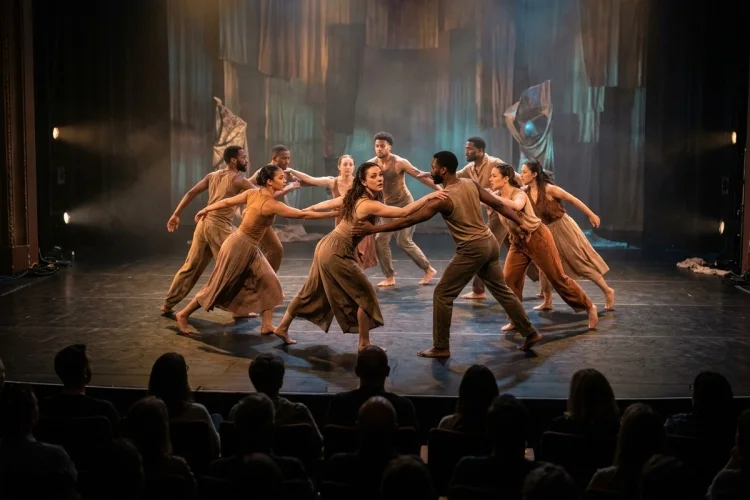
Lighting can direct attention, change the mood, or reveal only part of the stage. A narrow spotlight may create isolation, while a bright open stage can suggest freedom or celebration.
Costumes affect both appearance and movement. Flowing fabric may emphasise turns and travelling patterns, while a structured outfit can make gestures appear sharper.
Props should have a clear purpose. An object becomes memorable when it changes the dancer’s choices or represents something important, not simply because it looks attractive.
Even silence can function as a production element. Hearing breathing, footsteps, or contact with the floor can make the physical effort feel immediate and intimate.
Research on spectatorship suggests that some viewers value this sense of closeness and awareness of dancers’ physical intensity.
Before adding a visual or technical element, choreographers should ask whether it clarifies the idea. When everything competes for attention, the central message can disappear.
Preparation Allows Performers to Be Fully Present
Memorable performances often look spontaneous, but they are built through preparation. Dancers need to know the choreography well enough that they are not constantly trying to remember what comes next.
Rehearsal should include more than repeating steps. Performers need to practise transitions, spacing, musical cues, expressions, entrances, exits, and recovery from mistakes.
Full-energy rehearsals are useful because a routine can feel very different when performed under stage lighting, in costume, or in front of an audience. However, constant full-out practice can create unnecessary fatigue.
Mental rehearsal can help dancers review timing and intention without repeatedly placing the same load on the body. Marking sections at reduced intensity can also support memory and coordination.
A mistake does not automatically ruin a performance. Audiences may not notice a missed step when the dancer remains committed, returns to the choreography smoothly, and continues communicating the work.
Professional dancers describing peak performance often emphasise complete involvement in the moment, alongside their relationship with the audience, music, and choreography.
Presence therefore depends partly on preparation: the more secure the material feels, the more attention dancers can give to expression.
A Powerful Ending Leaves a Lasting Image
The final moments of a dance deserve as much care as the opening. An ending should feel intentional rather than occurring only because the music stops.
The choreography might return to an earlier gesture, resolve a relationship, leave a question unanswered, or finish with an unexpected contrast. A quiet ending can be just as effective as a dramatic final jump.
Dancers should maintain focus after the final movement. Relaxing too early, looking toward the wings, or adjusting a costume can break the atmosphere before the audience has processed the ending.
Hold the final image long enough for it to register. Allow the silence or music to settle before leaving the performance space.
A memorable ending does not need to explain everything. Sometimes the strongest conclusion leaves the audience with an emotion or idea they continue thinking about later.
A memorable dance performance combines clear intention, reliable technique, musicality, expressive dynamics, thoughtful choreography, and genuine audience connection.
Production elements and careful preparation strengthen the experience, but they should always support the movement rather than overpower it.
The goal is not to perform the greatest number of difficult steps. Audiences are more likely to remember a moment that feels honest, surprising, or emotionally clear.
During your next rehearsal, identify the central idea of the dance and choose one moment you want viewers to carry home. Refine its timing, energy, focus, and meaning.
When every choice serves that moment, a routine can become an experience that remains long after the curtain closes.