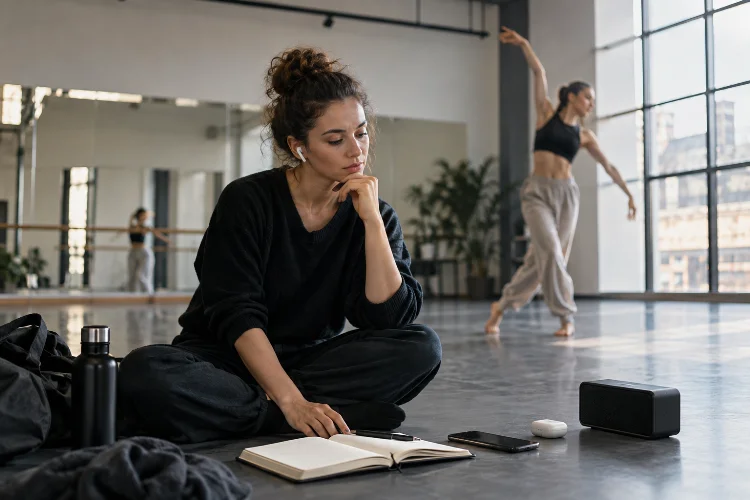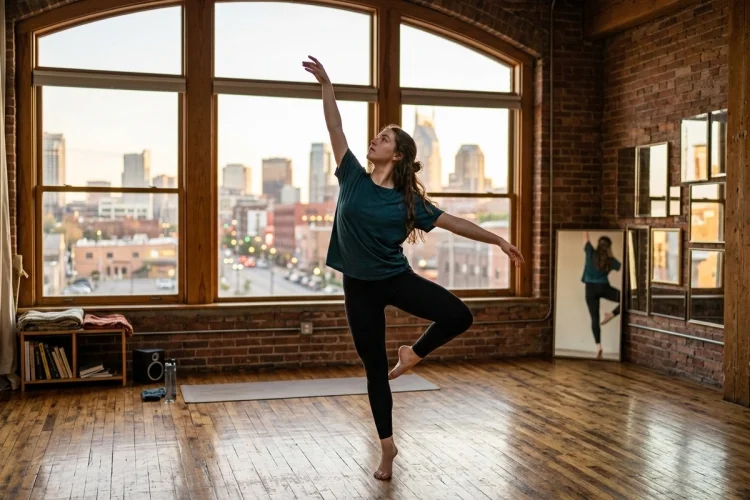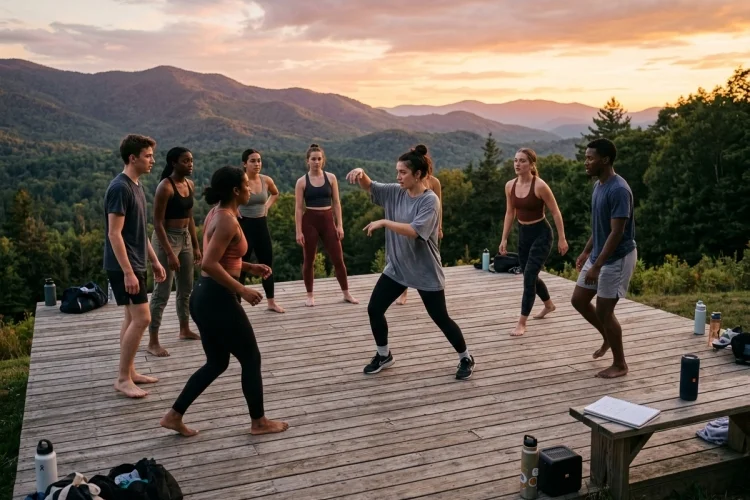
Having an idea for a dance is easy. Turning that idea into something people can actually see, feel, and understand on stage is where the real creative work begins.
Maybe your starting point is “loneliness.” Perhaps it is a photograph, a memory of your hometown, a piece of music, climate change, friendship, or something as simple as falling leaves.
These ideas can sound exciting in your head, but they do not automatically tell you how the dancers should move.
Learning how to turn an idea into a dance concept means building a bridge between an abstract thought and physical movement.
Professional choreographers do this in many different ways. Some begin with improvisation, while others research their subject, write questions, create movement tasks, work collaboratively with dancers, or establish strict rules for themselves.
Rambert’s choreography resources encourage dancers to begin with a clear artistic intention and then develop original movement from a stimulus.
The good news is that you can use the same basic process, even if you are creating your first dance.
Start With the Core Idea
Before creating steps, try to understand what actually interests you about your original idea.
Suppose your starting point is “the ocean.” That is still extremely broad. Are you interested in waves, underwater movement, storms, isolation at sea, environmental pollution, or the emotional feeling of standing beside an enormous body of water?
The more specific your focus becomes, the easier it is to create meaningful choreography.
A useful question is:
What do I want the audience to experience?
If your idea is about friendship, for example, your answer might be, “I want the audience to see how two people can grow apart without completely losing their connection.”
Now you have something much more useful than the word “friendship.”
Rambert describes this stage as identifying choreographic intent-the purpose or artistic intention that guides later creative choices.
Your intention does not need to be complicated. In fact, a simple concept can often produce stronger choreography because you know exactly what you are exploring.
Turn Your Theme Into Movement Qualities
Once the concept is clearer, avoid jumping immediately into complete dance sequences.
Instead, translate the idea into physical qualities.
Imagine your concept is about feeling trapped. Words connected with that idea might include restricted, repetitive, heavy, narrow, tense, or interrupted.
Those words can become movement instructions.
A dancer could repeat the same gesture while gradually making it smaller. Another movement might begin freely before suddenly stopping. You could restrict dancers to one small area of the stage rather than letting them travel everywhere.
Now the concept is starting to become physical.
Rambert’s choreography materials recommend using specific prompts and parameters to help dancers translate ideas into original movement.
For example, changing body parts, pathways, rhythm, focus, or spatial direction can create completely different interpretations of the same stimulus.
The goal at this stage is not perfection.
Think of it as collecting raw material. Some ideas will disappear later, while others may become the most memorable moments in the finished dance.
Use Improvisation to Generate Movement
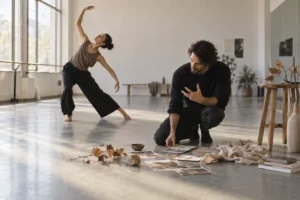
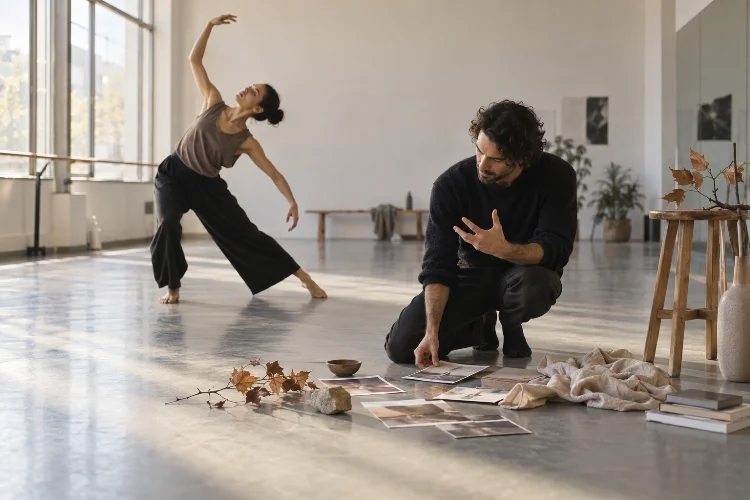
Improvisation is one of the easiest ways to move from thinking into doing.
Instead of deciding exactly what every movement should look like, give yourself or your dancers a task.
For example, imagine the concept is “trying to hold onto a memory.”
You could improvise using the instruction: “Reach toward something that keeps moving farther away.”
Try it for two or three minutes without worrying about creating polished choreography.
You might discover an interesting arm gesture, a sudden turn, a moment of stillness, or a particular way of falling backward. Record the session so you can review it later.
Wayne McGregor demonstrated this type of choreographic thinking in his TED presentation, where dancers responded to physical and visual instructions and transformed those prompts into movement in real time.
This is an important creative lesson.
You do not always need to know the finished dance before you begin. Sometimes the body discovers possibilities that your conscious mind would never have planned.
That seemingly messy begining can be extremely productive.
Build a Movement Vocabulary
After experimenting, look for movements that seem connected to your central idea.
These movements become the vocabulary of your dance.
Suppose you have created six interesting actions: reaching, folding inward, stepping backward, rotating the shoulders, dropping suddenly, and extending one hand.
You can now manipulate them.
Make one movement slower. Reverse another. Repeat the hand gesture several times. Perform the same phrase at different levels. Let two dancers perform it simultaneously while facing opposite directions.
A small amount of material can produce many possibilities.
Merce Cunningham famously demonstrated how movement sequences could be reorganized through chance procedures.
In works such as Suite by Chance, movement, timing, direction, entrances, exits, and even the number of performers could be determined through structured chance methods.
You do not need to use Cunningham’s exact system.
The larger lesson is that choreography is partly about manipulating material. Creating a movment is only the first step; changing its timing, direction, size, order, and relationship to other movements can completely transform it.
Decide How the Dance Will Develop
A collection of interesting movements is not yet a complete dance.
The choreography needs some kind of journey.
This does not mean every performance requires a traditional story with a beginning, conflict, and ending. Abstract dance can still have development.
For example, imagine your concept is “crowd pressure.”
At the beginning, one dancer might move independently while five others remain still.
Later, the group begins copying the solo dancer.
Eventually, the situation reverses: the group moves as one unit while the original dancer struggles to maintain an individual movement pattern.
That creates progression.
Ask yourself what changes between the beginning and the end. Perhaps the dancers become more connected, more chaotic, more exhausted, more confident, or increasingly separated.
Structure gives the audience a reason to stay curious.
Even repetition becomes more interesting when something changes each time it returns.
Explore Space, Time, and Relationships
Where dancers move can communicate just as much as what they do.
Imagine two performers standing several meters apart with their backs facing each other. Now imagine those same dancers standing almost shoulder to shoulder.
The movement could remain identical, but the audience might interpret the relationship very differently.
Rambert’s choreography exercises specifically encourage experimenting with formations, proximity, facing, and pathways because spatial choices can change how movement is perceived.
Timing matters too.
A quick movement may communicate urgency, while performing the same action extremely slowly could suggest hesitation or emotional weight.
You can also experiment with relationships between dancers. They might move in unison, mirror each other, interrupt one another, perform the same phrase at different times, or deliberately avoid contact.
Do not treat these elements as seperate decorations added after creating the steps.
They are part of the concept itself.
Think Carefully About Music and Sound
A common beginner mistake is choosing a favorite song first and then simply creating movements that match its beat.
That approach can work, but it is only one possibility.
Ask what role the sound should play.
Should the music support the emotional atmosphere? Should the movement contrast with it? Would spoken words help? Could silence make one section more powerful?
You might even create the choreography first and choose the music later.
Merce Cunningham frequently challenged the assumption that dance and music needed to be directly synchronized.
His broader choreographic practice explored independent structures and chance-based organization, opening different possibilities for how audiences experience movement and sound.
Try watching your choreography without music.
If the movement still communicates something interesting, you probably have a stronger dance concept than one that depends entirely on a soundtrack.
Edit, Test, and Refine the Concept
Choreography improves through editing.
Record a rehearsal and watch it as if you were seeing the piece for the first time.
Ask whether every section supports the original intention.
Sometimes an impressive sequence needs to be removed because it does not belong. A simpler gesture may communicate your idea much more clearly.
Feedback can also help.
Show an unfinished version to someone without explaining the concept first. Ask what emotions, relationships, or ideas they noticed.
Their answer does not need to match your intention perfectly. Dance allows interpretation.
However, if your work is supposed to communicate tension and everyone describes it as relaxed and cheerful, you may want to reconsider some choices.
Creative work is naturally iterative. Dance/USA describes choreographic creation as a cyclical process involving building, adjusting, listening, responding, and allowing new discoveries to influence the direction of the work.
Do not be afraid of changing your original plan.
Sometimes the most spontanous discovery in rehearsal becomes the central idea of the finished choreography.
Learning how to turn an idea into a dance concept is really about translating thoughts into physical choices.
Begin by narrowing your idea and deciding what you want to explore. Turn that intention into movement qualities, experiment through improvisation, develop a movement vocabulary, and then organize the material through space, timing, relationships, sound, and structure.
Most importantly, allow the concept to evolve.
Choreography rarely moves in a perfectly straight line from idea to finished performance. Experimentation, mistakes, unexpected discoveries, and editing are all part of the process.
If you have an idea for a dance, do not wait until you know exactly what the finished piece should look like. Choose three words that describe your concept, create one movement for each, and start experimenting. The dance can reveal itself as you build it.