A great dance can look as though it appeared naturally with the music. Every turn lands at the right moment, dancers move into satisfying formations, and the ending feels like the only possible way the piece could finish.
Behind that polished performance, however, is a process called choreography. So, what is choreography? In simple terms, it is the art of selecting, arranging, and developing movement into a complete dance.
A choreographer makes decisions about steps, timing, spacing, formations, energy, music, and meaning. The result might be a three-minute solo, a large theatrical production, a social media routine, or an experimental work performed without music.
Choreography is not limited to professional dance companies. Beginners can start with a few everyday gestures and turn them into an organised movement phrase.
You do not need hundreds of impressive steps. You need a clear idea, curiosity, and the willingness to experiment, revise, and sometimes remove movements that do not serve the piece.
What Does Choreography Actually Mean?
The U.S. Copyright Office describes choreography as the composition and arrangement of dance movements and patterns. This definition highlights an important point: choreography is not just movement itself but the way movement is intentionally organised.
A person walking across a room is performing an action. A choreographer might transform that action by changing its speed, repeating it, adding pauses, altering its direction, or giving it emotional meaning.
The person who creates the dance is called a choreographer. However, choreography can also be collaborative. Dancers may improvise, suggest material, or interpret instructions, while the choreographer selects and shapes the final version.
Not every routine needs to tell a literal story. Choreography can explore a feeling, visual pattern, musical structure, cultural idea, or physical challenge. It can also be created simply for entertainment.
The Elements That Shape a Dance
Choreographers work with more than individual steps. The National Core Arts Standards describes the main elements of dance through the body, space, time, and energy.
1. Body and Movement
The body is the choreographer’s main instrument. Movement can involve the whole body or focus on one area, such as the hands, shoulders, head, or feet.
Actions may include travelling, turning, jumping, bending, reaching, falling, shaking, or becoming completely still. Even a basic step can feel original when it is combined with an unusual gesture or movement quality.
2. Space and Formation
Space includes direction, pathway, level, size, focus, and the distance between dancers. A performer might travel in a straight line, spiral around the stage, remain in one small area, or move from a low position toward a high one.
Group choreography also requires formations. Dancers may create lines, circles, clusters, diagonals, or constantly changing patterns. These arrangements guide the audience’s attention and affect the emotional atmosphere.
3. Time and Energy
Time includes tempo, rhythm, duration, accents, and pauses. Energy describes whether movement feels heavy, light, sharp, smooth, controlled, relaxed, explosive, or sustained.
Imagine a dancer raising one arm. The action could happen slowly with gentle energy, or it could strike upward on a loud musical accent. The pathway is similar, but the meaning changes completely.
Choreography and Music: More Than Counting Beats
Music often gives choreography its timing and emotional direction. Dancers may follow the beat, melody, lyrics, bass line, or small instrumental details.
Counting helps organise movement. Many routines are taught in groups of eight counts because this structure fits much popular music. However, a choreographer should not depend only on numbers.
Strong choreography also responds to musical phrasing. A movement may grow as the music becomes louder, stop during a moment of silence, or continue smoothly across several beats.
The movement does not always need to match the soundtrack directly. A cheerful song paired with tense or restrained movement can create contrast. Some choreographers use spoken text, breathing, environmental sounds, or silence instead of conventional music.
The Royal Ballet School’s choreographic programme includes timing, space, improvisation, gesture, music, and the development of new ideas, showing how musical choices form only one part of a wider creative process.
Structure Gives Choreography a Clear Direction
A collection of interesting moves does not automatically become a complete dance. Choreography usually needs a structure that helps the audience understand how the material develops.
The National Core Arts Standards lists forms such as AB, ABA, and theme and variation as examples of dance structures. In an AB structure, one movement idea is followed by a contrasting section. ABA returns to the original material after the contrast.
Theme and variation begins with one main phrase and presents changed versions of it. The choreographer might alter the speed, direction, level, energy, or body parts involved.
A dance can also follow a narrative structure with a beginning, conflict, development, and resolution. Abstract work may instead build toward a visual or emotional climax.
For beginners, a simple beginning, middle, and ending is enough. Introduce a movement idea, develop it, and finish in a way that feels intentional rather than stopping because the music has ended.
Choreographic Devices Create Variety
Choreographic devices are techniques used to manipulate existing movement. They help creators develop a short phrase without constantly inventing completely new steps.
Common devices include repetition, accumulation, inversion, retrograde, canon, and call and response.
Retrograde means performing material backward, while accumulation gradually adds one movement at a time. In a canon, dancers begin the same phrase at different moments, creating a ripple effect.
Repetition is particularly useful because it gives the audience something recognisable. However, repeating a phrase too many times without variation may make the work predictable.
Try repeating the same gesture three times with different energy. The first version might be soft, the second nervous, and the third forceful. One simple action can then become a developing idea.
These tools work in ballet, contemporary dance, hip-hop choreography, jazz, traditional forms, and many other genres. The movement vocabulary may change, but the basic compositional thinking remains useful.
How Choreographers Find and Develop Ideas
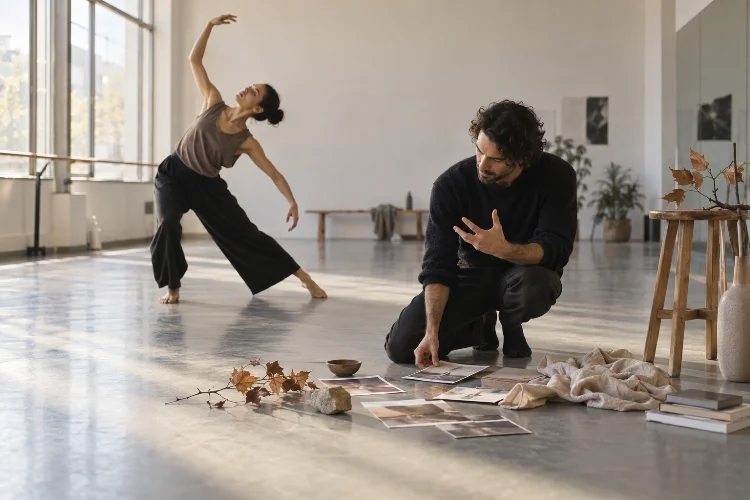
Choreography can begin with almost anything. Music is a common starting point, but creators also use images, objects, memories, words, places, social issues, personal experiences, and observed movement.
National dance standards encourage generating choreography from stimuli such as sound, text, objects, images, notation, existing dance, and everyday experiences.
Suppose your theme is “waiting.” You could begin by writing down related actions: checking the time, looking toward a door, pacing, sitting, standing, and sighing.
Turn those actions into larger or more stylised movements. Change their rhythm, repeat them, and connect them with transitions. The original idea remains visible, but it becomes dance rather than ordinary behaviour.
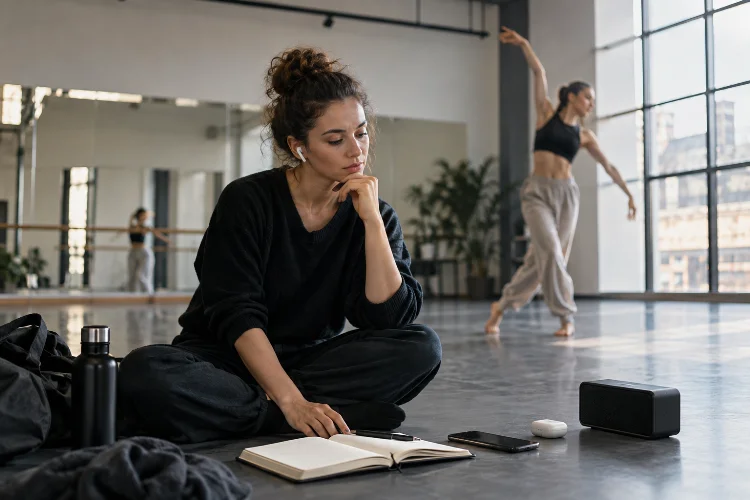
Improvisation can help when you feel stuck. Play a song or set a timer for one minute and move without judging yourself. Record the session, identify two or three moments you like, and build a short phrase from them.
How to Create Your First Choreography
Begin with a clear but manageable idea. Choose one emotion, image, or short piece of music rather than attempting to communicate several unrelated themes.
Create a movement phrase lasting about 20 to 30 seconds. Use steps you can perform confidently, then include changes in direction, level, speed, and energy.
Next, decide on the structure. You might perform the phrase once, repeat a changed version, and finish by returning to the opening gesture.
Record yourself and watch the video without music. Check whether the movement still has clear shapes, transitions, and intention. Then watch it with the soundtrack and notice whether important moments connect with the musical phrasing.
Revision is a normal part of choreography. Remove movements that feel unnecessary, simplify awkward transitions, and repeat the strongest ideas. Feedback from a teacher or trusted dancer can reveal details you may not notice yourself.
Choreographers also document their work through video, written notes, diagrams, or formal notation. The Library of Congress maintains a Dance Notation Collection containing scores, choreographic notes, diagrams, and descriptive records of movement.
Choreography is the art of transforming movement into an organised and meaningful dance. It combines body actions with space, timing, energy, musicality, structure, and artistic intention.
You do not need advanced technique or a large group of dancers to begin. A short sequence built from walking, reaching, turning, and pausing can become choreography when those actions are arranged thoughtfully.
Start with one simple idea, create a brief phrase, experiment with repetition and contrast, and record the result. Most importantly, allow yourself to revise.
Choreography rarely appears perfectly on the first attempt-the creative process is where the dance gradually discovers what it wants to become.