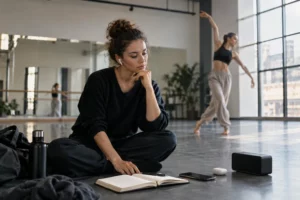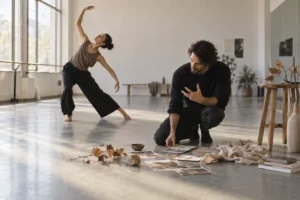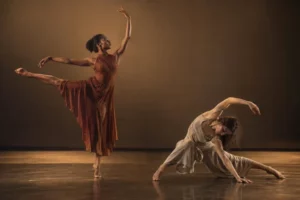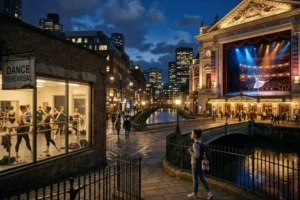

A dancer walks across a busy train station. Someone drops a bag, another person rushes toward the platform, and a child spins in circles while waiting for a parent. To most people, it is just another ordinary moment.
To a choreographer, it could become the beginning of a dance.
So, where do choreographers find inspiration? The answer is almost everywhere. Music, memories, conversations, paintings, architecture, political events, natural landscapes, everyday gestures, and even accidents in the rehearsal studio can become starting points for choreography.
There is no universal formula. Some choreographers begin with a clear story, while others start with a physical idea and discover the meaning later. Some work closely with music from the first rehearsal, while others create movement in silence.
Professional choreographers also frequently involve dancers in the creative process rather than arriving with every step already planned. Organizations such as Rambert document a wide range of choreographic processes, showing just how differently dance artists can develop ideas.
Understanding these sources of inspiration can make choreography feel far less mysterious.
1. Music Can Be the Starting Point
Music is probably one of the most familiar sources of choreographic inspiration.
A choreographer may hear a song and immediately imagine a particular rhythm, gesture, character, or atmosphere. Fast percussion might suggest sharp footwork, while a slow string composition could inspire sustained movements and long pauses.
But choreographers do not simply “dance to the beat.”
They may study the structure of the music, including changes in tempo, instrumentation, repetition, silence, and emotional tone.
Choreographer Mark Morris, for example, is widely recognized for his close attention to musical structure and has created dances using music from many different traditions and genres.
Other artists deliberately separate dance from music.
Merce Cunningham famously developed choreography in ways that allowed movement and music to exist independently. His collaborations with composer John Cage helped demonstrate that choreography did not always need to illustrate every musical phrase.
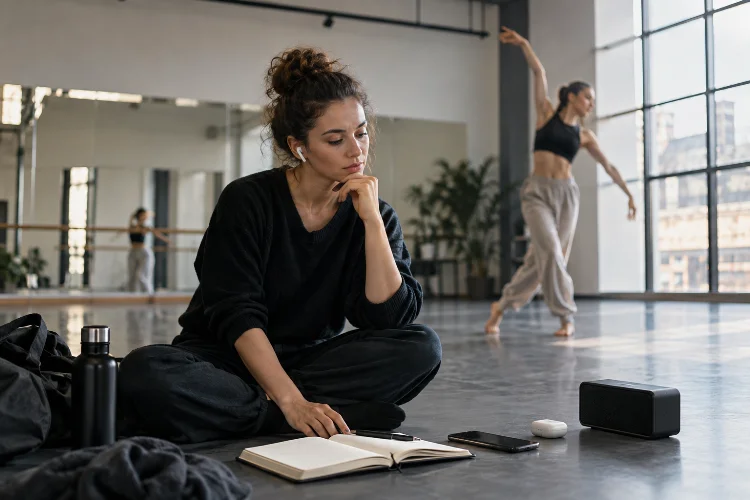
For beginner choreographers, listening to the same piece several times can reveal very different possibilities. Instead of immediately creating steps, try listening first for texture, mood, silence, and unexpected details.
2. Personal Experiences and Memories
Some of the most powerful choreography begins with something personal.
A choreographer may draw from childhood memories, family relationships, migration, friendship, grief, cultural identity, love, or major changes in life. These experiences can provide both emotional material and specific physical images.
That does not mean the final performance has to become a literal autobiography.
A memory of saying goodbye to someone, for example, might inspire a duet built around dancers repeatedly reaching toward each other without making contact. The audience does not need to know the original story for the movement to communicate separation or distance.
Jacob’s Pillow maintains a collection of dance works that deliberately explore personal and autobiographical stories, demonstrating how choreographers can transform lived experiance into performance.
Personal inspiration can be especially useful because it gives choreography an emotional anchor.
Instead of asking, “What cool movements should I make?” a choreographer might ask, “What did this moment feel like, and how could a body communicate that feeling?”
That question usually leads to much more specific creative choices.
3. Everyday Human Movement
Choreographic ideas do not always begin with traditional dance steps.
Walking, sitting, opening a door, tying a shoe, carrying groceries, shaking hands, brushing hair, or waiting impatiently can all become movement material.
Choreographer Ryan Heffington has discussed how ordinary actions, including everyday household movements, can become sources of choreographic inspiration.
His approach illustrates an important creative lesson: movement does not need to look technically difficult before it becomes interesting.
The transformation happens through choreography.
Imagine someone repeatedly reaching for an object. A choreographer could make that gesture extremely slow, perform it backward, exaggerate its size, repeat it twenty times, or transfer the action from the hand to the entire body.
Suddenly, an ordinary action becomes something unfamiliar.
Observation therefore becomes a valuable skill for choreographers. Watching how people naturally move through different enviroments can provide an enormous library of physical ideas.
4. Visual Art, Film, and Architecture
Dance is visual, so it makes sense that choreographers often find ideas in other visual art forms.
Paintings can inspire color, shape, composition, and emotional atmosphere. Sculpture may suggest ideas about balance, weight, stillness, or three-dimensional form.
Film provides another rich source.
A choreographer might become interested in cinematic ideas such as slow motion, repeated scenes, close-ups, sudden cuts, or simultaneous events. Those concepts can then be translated into movement rather than copied directly.
Architecture can influence choreography too.
A staircase encourages different movements from an empty studio. A narrow corridor restricts pathways, while a large outdoor plaza may encourage expansive group formations.
Merce Cunningham explored new spatial possibilities throughout his career, including work for stage, film, video, and unusual performance environments. He described working with camera space as a challenge that also opened possibilities unavailable on a traditional stage.
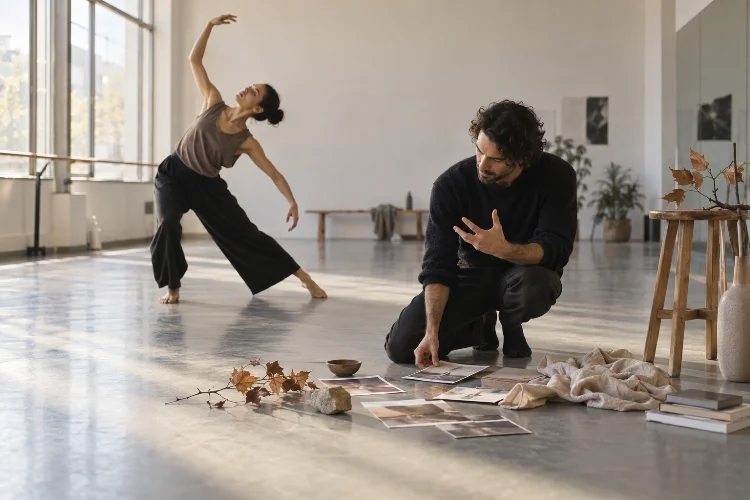
A useful exercise is to choose one photograph or building and ask what qualities it contains: symmetry, tension, repetition, height, isolation, curves, or sharp angles.
Those visual qualities can become movement instructions.
5. Dancers Can Inspire the Choreography
The choreographer is not always the only person generating ideas.
In many contemporary creative processes, dancers contribute actively to the development of movement.
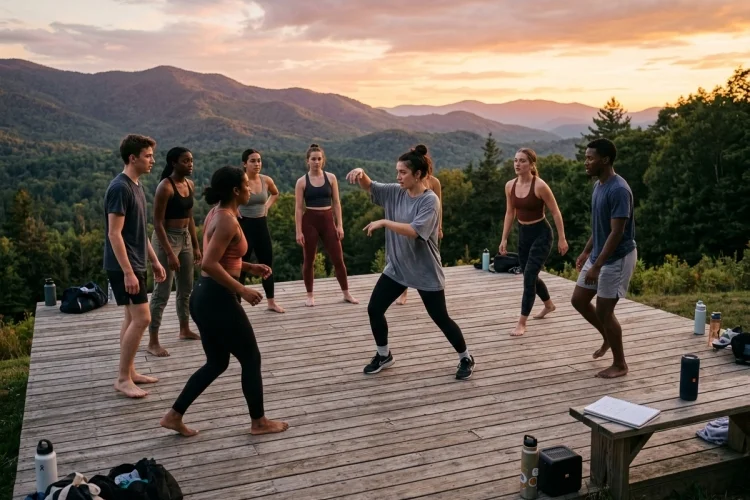
A choreographer might give performers a task such as, “Create a phrase based on three memories,” or “Move as if different parts of your body are being pulled in opposite directions.” The dancers experiment, and the choreographer selects, changes, combines, or reorganizes the results.
Choreographer Didy Veldman has spoken about being inspired by the individuality and personality of dancers, valuing differences between performers rather than trying to make everyone move identically.
That kind of colaboration can produce movement that would be difficult for one person to invent alone.
Different dancers have different bodies, histories, movement habits, and creative instincts. When they contribute ideas, choreography can grow in unexpected directions.
This is why good choreographers often spend as much time watching and asking questions as they do demonstrating steps.
6. Stories, Social Issues, and Big Questions
Choreography can also begin with an idea rather than movement.
A choreographer might become interested in climate change, war, technology, inequality, community, gender, migration, loneliness, artificial intelligence, or another subject affecting society.
The challenge is turning an abstract topic into physical material.
For example, choreography about social isolation does not need dancers to literally act lonely. A choreographer might instead create a group where everyone moves together except one person who repeatedly fails to match the others.
Stories can work in a similar way.
Some choreographers tell recognizable narratives with characters and clear events. Others borrow only one theme, image, or emotional conflict from a story.
Akram Khan’s choreographic work is strongly associated with storytelling, collaboration, and a movement language influenced by his background in kathak as well as contemporary performance.
In an interview with Sadler’s Wells, he discusses storytelling and collaboration as important parts of his artistic approach.
The original inspiration therefore does not determine the final form. One idea can lead to hundreds of possible dances.
7. Improvisation, Chance, and Happy Accidents
Sometimes inspiration appears only after the choreographer starts moving.
Improvisation allows dancers to experiment without knowing exactly what the finished result will look like. A strange transition, accidental fall, unusual pause, or spontenous gesture can suddenly become the most interesting part of a piece.
Wayne McGregor has demonstrated this kind of exploratory choreographic thinking by working with dancers in real time, transforming mental and physical instructions into movement phrases.
Some artists go even further by intentionally giving up part of their control.
Merce Cunningham famously used chance operations to determine elements such as movement order, timing, spatial arrangement, and which dancers performed particular material. He believed these methods could reveal movement possibilities he might not have consciously chosen.
That is an important reminder for new choreographers.
Creative inspiration does not always arrive before rehearsal. Sometimes rehearsal is what creates the inspiration.
Instead of waiting for the “perfect idea,” start experimenting. Make five gestures, change their order, reverse them, alter the timing, and see what happens.
How Choreographers Turn Inspiration Into Movement
Finding an idea is only the beginning.
Once a choreographer has a source of inspiration, they need to translate it into movement choices. This process may involve improvisation, research, movement tasks, discussion with dancers, video recording, repetition, and extensive editing.
Wayne McGregor’s creative demonstrations show how ideas can be transferred into physical instructions and then interpreted differently by individual dancers.
A useful beginner method is to identify three qualities from your inspiration.
Suppose your inspiration is a thunderstorm. You might choose “sudden,” “heavy,” and “unpredictable.” Instead of pretending to be a storm, create movements that physically express those three qualities.
Next, experiment with space and timing.
Make one movement unexpectedly fast. Move another close to the floor. Repeat one gesture until it changes meaning.
The original idea provides direction, but the choreographic process gradually creates its own world.
So, where do choreographers find inspiration? Almost anywhere. Music, memories, everyday gestures, artwork, architecture, dancers, social issues, stories, improvisation, and even random decisions can all become starting points for original choreography.
What matters most is not finding an idea nobody has ever used before. It is discovering a personal way to investigate that idea through movement.
Great choreography often begins with curiosity rather than certainty.
If you want to experiment, choose something ordinary today-a photograph, a memory, a song, or even the way someone walks across a room. Identify three qualities that interest you and create a short movement phrase from them.
You may discover that inspiration was never particularly far away. The real skill is learning how to notice it.