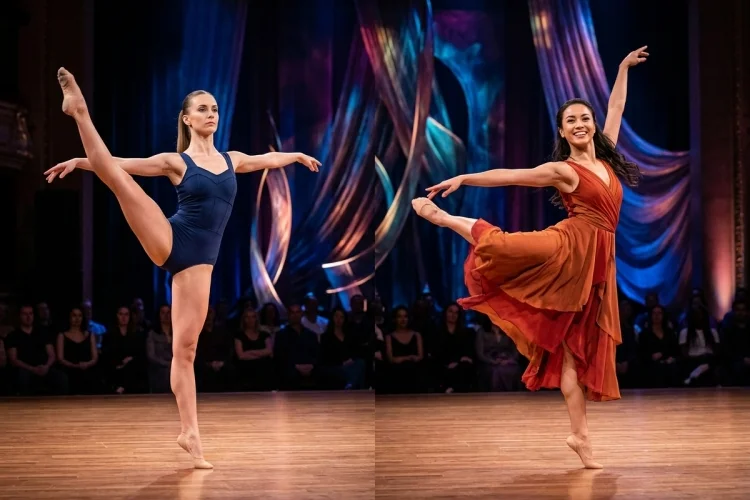
Two dancers perform the same routine. The first has beautiful lines, controlled turns, and precise footwork, but their face and energy reveal very little.
The second makes a few technical mistakes, yet their musicality, confidence, and emotional commitment keep everyone watching. Which dancer gives the better performance?
The debate around dance technique vs. performance quality often makes them sound like competing skills. Technique represents physical control and accuracy, while performance quality describes how convincingly a dancer communicates movement to an audience.
In practice, however, the strongest dancing usually appears when both sides support each other. Technique gives performers the physical tools to execute choreography.
Performance skills turn those movements into an artistic experience. A dancer needs enough control to express an idea clearly, but perfect placement means little when the performance feels disconnected or emotionally empty.
Understanding the difference can help dancers practise more effectively, receive feedback with less confusion, and become performers rather than people who simply complete a sequence of steps.
Understanding Dance Technique and Performance Quality
Dance technique refers to the physical skills and movement principles required by a particular style. These may include alignment, balance, coordination, posture, weight transfer, flexibility, strength, timing, and control.
The exact technical standard changes between genres. A ballet dancer may focus on turnout, classical lines, and controlled landings. A hip-hop dancer may develop grooves, isolations, grounded movement, and rhythmic precision.
Performance quality is broader. It includes musicality, emotional expression, focus, projection, movement dynamics, confidence, commitment, and connection with an audience.
The National Core Arts Standards describes performance as more than executing movement. Dancers also develop, interpret, refine, and present artistic work in ways that convey meaning.
This means technique answers the question, “Can the dancer perform the movement?” Performance quality asks, “What does the movement communicate?”
What Strong Dance Technique Brings to a Performance
Technique creates a reliable physical foundation. It helps dancers maintain balance, change direction efficiently, control momentum, and repeat choreography with greater consistency.
Imagine a dancer performing a pirouette. Good preparation places the body over the supporting foot, organises the pelvis, coordinates the arms, and controls the finishing position. Without these foundations, the performer may spend the entire turn trying not to fall.
Alignment is particularly important because it affects both movement efficiency and visual clarity.
Guidance from the International Association for Dance Medicine & Science identifies proper alignment as a basic building block of dance technique and explains how weight placement and pelvic organisation influence positions such as retiré and movements such as pirouettes.
Technical training can also create artistic freedom. When dancers no longer need to think constantly about basic foot placement, balance, or choreography, they can give more attention to music, character, and relationships on stage.
However, technique should not mean stiffness. True control includes the ability to become soft, loose, off balance, sharp, or explosive when the choreography requires it.
What Performance Quality Actually Includes
Performance quality is the way dancers bring choreography to life. It is visible in how they use energy, timing, focus, breath, facial expression, and intention.
A performer with strong stage presence appears mentally and emotionally involved. They do not look as though they are remembering instructions or waiting for the next difficult step.
Musicality is another central part of performance. Musical dancers respond not only to counts but also to rhythm, melody, accents, silence, and changes in intensity.
Research involving professional dancers suggests that some performers naturally synchronise more accurately with rhythm, while others respond more closely to melody. This difference can influence how dancers learn, memorise, and present choreography.
Dynamics also shape performance quality. A movement can be heavy, light, sharp, smooth, sustained, restrained, or explosive. Changing these qualities gives a routine contrast and helps an audience recognise important moments.
Even stillness can become powerful when it has clear intention. Standing completely still because you forgot the choreography is different from holding a pause that creates tension.
Why One Cannot Fully Replace the Other
A highly expressive dancer may capture attention, but weak technical control can limit what they communicate. Unstable turns, uncontrolled landings, poor timing, or unfinished transitions may interrupt the audience’s connection with the work.
At the same time, a technically excellent dancer can look unconvincing when every movement has the same energy or when their expression feels disconnected from the choreography.
The relationship is similar to speaking. Technique provides vocabulary, pronunciation, and sentence structure. Performance quality provides tone, personality, emotion, and purpose.
The Royal Ballet School reflects this combined approach in its training system. It aims to develop clean classical technique alongside musicality, movement quality, joy, and the dancer’s growth as an expressive artist.
Neither side should be treated as decoration. Expression is not something added after technique becomes perfect, and technical training is not an obstacle to creativity.
Dancers can begin developing both from their first class. A beginner performing a simple step-touch can practise accurate weight transfer while also exploring rhythm, focus, and confidence.
Musicality and Dynamics Bridge the Gap
Musicality is one of the clearest places where technique and performance quality meet. A dancer needs timing control to arrive with the music, but they also need artistic awareness to decide how to interpret it.
Consider a four-count arm movement. Technically, the arm may travel through the correct pathway and reach the final position on count four.
The performer could move steadily across all four counts. Alternatively, they might begin slowly, accelerate on count three, and arrive sharply with a musical accent. Both versions use the same choreography, but the second makes a more specific musical choice.
Dynamics work in a similar way. A technically controlled dancer can intentionally vary speed, force, flow, and tension without losing alignment or clarity.
Try performing one short phrase three times. Make the first version smooth, the second powerful, and the third nervous or hesitant. This exercise reveals how movement quality can transform meaning without changing the steps.
Counts help dancers organise timing, but listening only to counts can produce mechanical movement. Use numbers to learn the structure, then connect the choreography with the actual sounds and emotional direction of the music.
Performance Quality Depends on Context
There is no single universal formula for a “good” dance performance. Expectations change according to the genre, choreography, venue, audience, and purpose of the work.
A competition routine may reward clarity, difficulty, synchronisation, and projection. An experimental contemporary piece may intentionally use awkwardness, restraint, repetition, or pedestrian movement.
A musical-theatre dancer needs to communicate character and story, while a freestyle performer may be judged on originality, musical response, and personal style.
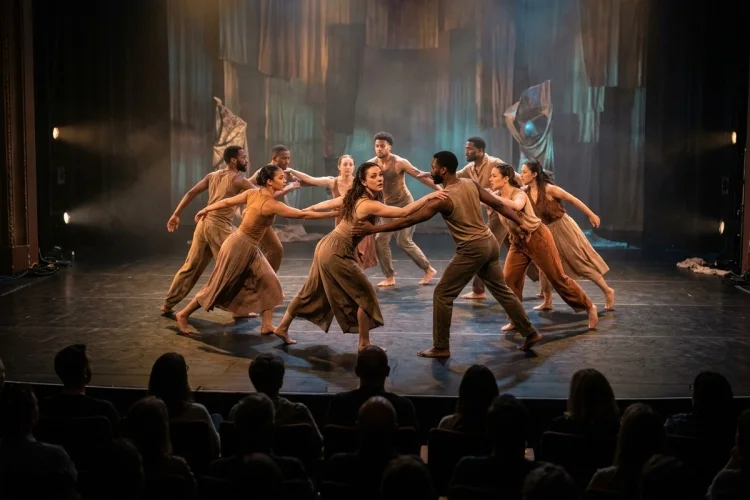
In a group performance, synchronisation and spatial relationships can become more important than individual tricks. Research shows that assessing dance performance quality is complex.
A 2024 systematic review found limited evidence supporting many existing assessment methods, with only one measure showing relatively promising evidence for validity and reliability. This suggests that dance quality cannot always be reduced to one simple score.
Audiences also respond to more than technical difficulty. Research on group dance has found that synchrony between performers can predict engagement among spectators, highlighting the importance of coordination and collective movement.
A dancer must therefore understand what a particular work needs instead of applying the same performance style to everything.
How to Train Technique and Performance Together
Do not wait until the choreography is technically perfect before adding performance. Instead, include intention and musicality from the beginning.
First, learn a short section slowly and check its physical foundations. Notice your alignment, weight placement, balance, transitions, and timing. Correct major problems before increasing the speed.
Next, identify the purpose of the phrase. Decide what emotion, relationship, image, or movement quality it should communicate.
Perform the section again while focusing on one artistic layer. You might concentrate on musical accents, eye focus, breath, dynamics, or interaction with another dancer.
Record yourself and watch the video twice. During the first viewing, examine technical details. During the second, ignore minor mistakes and ask whether the performance has energy, direction, and meaning.
Avoid trying to correct ten things at once. Choose one technical goal and one performance goal for each rehearsal. For example, you might work on maintaining your supporting-leg alignment while making your focus clearer.
Professional dancers describing peak performance have highlighted a combination of technical, physical, psychological, and artistic preparation.
They also identified factors such as focus, confidence, music, the work itself, and audience connection as important parts of their strongest performances.
Finally, practise recovery. A small mistake does not have to destroy the performance. Continue with commitment, reconnect with the music, and return to the choreography without displaying panic.
The debate over dance technique vs. performance quality does not need a single winner. Technique gives dancers control, consistency, and the physical vocabulary needed to execute choreography.
Performance quality gives that vocabulary meaning through musicality, dynamics, intention, confidence, and audience connection. Strong performers train both areas together.
They do not hide behind difficult tricks, but they also do not use expression as an excuse to ignore physical foundations. During your next rehearsal, choose one technical detail to refine and one artistic idea to communicate.
Then repeat the phrase until control and expression feel like parts of the same movement. That is where technically correct dancing begins to become a convincing performance.