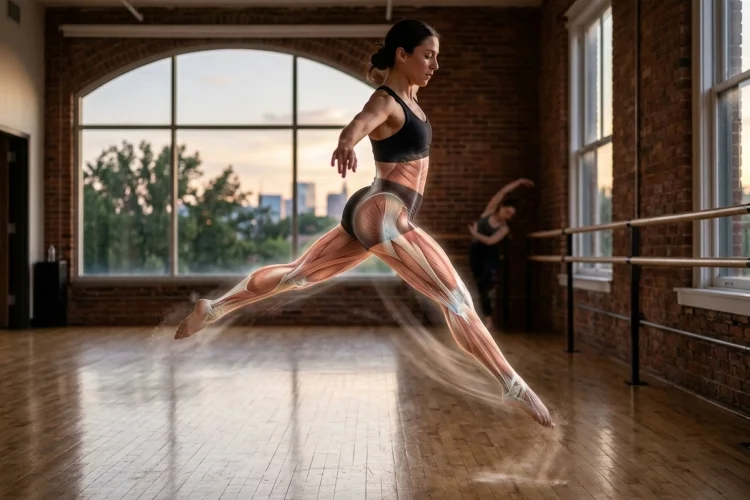
A dancer bends into a deep plié, pushes off the floor, turns in the air, and lands quietly. The movement may last only a few seconds, but the body performs an impressive amount of work during that time.
Muscles generate and control force, while joints allow bones to move in particular directions. Tendons transfer muscular force to bones, ligaments help stabilise joints, and the nervous system coordinates everything so the movement happens at the right speed and moment.
Understanding how muscles and joints work during dance can make technical corrections easier to apply. It can explain why bending the knees helps absorb a landing, why hip strength affects balance, and why a stable core does not mean keeping the torso permanently rigid.
Dancers do not need to memorise an entire anatomy textbook. A basic understanding of the musculoskeletal system is enough to make training more purposeful, efficient, and body-aware.
Muscles Create and Control Dance Movement
Skeletal muscles create tension and transfer that force through tendons to bones. When muscles pull on bones across a joint, they can produce actions such as bending the knee, lifting the arm, pointing the foot, or rotating the hip.
However, muscles do more than create visible movement. They also control speed, stabilise body positions, and prevent movements from continuing too far.
Muscles frequently work in coordinated groups. The muscle mainly responsible for an action is often called the agonist or prime mover. An antagonist produces the opposite action and may help slow or control the movement.
For example, the quadriceps at the front of the thigh help straighten the knee. The hamstrings at the back help bend it, but they can also assist in controlling the leg when it straightens quickly.
This teamwork is one reason dancers should avoid thinking that a single muscle performs an entire step. Even a simple leg extension requires cooperation between the hip, thigh, trunk, foot, and supporting-leg muscles.
Three Types of Muscle Contraction Appear in Dance
Muscles can produce tension in several ways. The three most useful types for dancers to understand are concentric, eccentric, and isometric contractions.
1. Concentric Contractions Create Movement
A concentric contraction happens when a muscle shortens while producing force. When you rise from a plié, the muscles extending the knees and hips shorten to move the body upward.
The calf muscles also contract concentrically during a relevé as the heels lift from the floor. In a jump, several muscle groups shorten rapidly to generate the force needed for take-off.
2. Eccentric Contractions Control Movement
An eccentric contraction happens when a working muscle lengthens while controlling a load. This type of muscle action is especially important during landings and deceleration.
When you lower slowly from relevé, your calf muscles continue working as they lengthen. When you land from a jump, muscles around the ankles, knees, and hips help control the downward movement instead of allowing the body to collapse.
3. Isometric Contractions Hold Positions
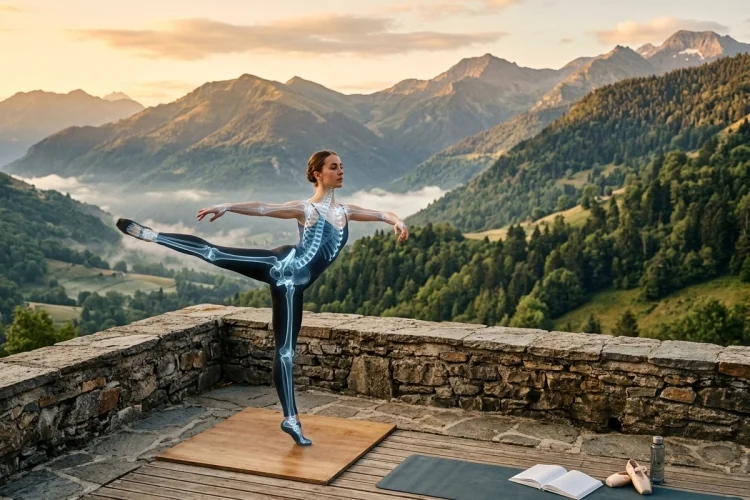
An isometric contraction produces tension without creating an obvious change in joint angle. Holding an arabesque, freeze, plank, or balanced pose involves considerable isometric work.
These three forms of contraction constantly overlap during choreography. A muscle may shorten to create a movement, hold briefly to stabilise a position, and then lengthen to control the return.
Joints Determine Where and How the Body Can Move
A joint is the place where two or more bones meet. Many of the joints used in dance are synovial joints, which allow substantial movement inside a fluid-filled joint cavity.
Different joint shapes permit different movement possibilities. The shoulder and hip are ball-and-socket joints, allowing movement in several directions as well as rotation.
The knee and ankle function mainly as hinge-type joints, although their real biomechanics are more complex than a simple door hinge.
Joint structure explains why dancers should not demand the same movement from every body part. The hip is designed to rotate, flex, extend, abduct, and adduct. The knee is primarily designed to bend and straighten.
Trying to create a large amount of turnout from the knees or feet instead of the hips can place unnecessary rotational stress on the lower limbs. Technique is most efficient when it respects the movement available at each joint.
Common Joint Actions in Dance
Dance uses combinations of basic anatomical movements. Learning their names can help dancers understand corrections and analyse choreography.
Flexion decreases the angle of a joint, such as bending the knees during a plié. Extension increases the angle, such as straightening the legs while rising.
Abduction moves a limb away from the body’s centre line, while adduction brings it back toward or across that line. Lifting a leg to the side involves hip abduction, although rotation and pelvic control also influence the final position.
Rotation turns a bone around its long axis. Ballet turnout uses external rotation of the legs at the hip, while contemporary or street choreography may use both internal and external rotation as expressive movement choices.
At the ankle, dorsiflexion brings the top of the foot toward the lower leg. Plantar flexion moves the foot in the opposite direction and contributes to pointing the toes, relevés, and jumping actions.
Actual choreography rarely uses one joint action in isolation. An arabesque, for example, combines hip extension and rotation with knee control, ankle positioning, spinal organisation, and coordinated upper-body movement.
How the Lower Body Handles Pliés, Jumps, and Landings
The hips, knees, ankles, and feet form a connected movement chain. A change in one area can affect the alignment and workload of the others.
During a plié, the hips, knees, and ankles bend together while the muscles control the descent. The feet provide contact with the floor, and the trunk helps keep the body’s weight organised over its base of support.
During take-off, the action reverses. Muscles around the hips, thighs, calves, and feet create force as the joints extend. The arms may contribute momentum depending on the dance style and choreography.
Landing requires controlled joint flexion. The hips, knees, and ankles bend to distribute force over time, while eccentric muscle action slows the body’s downward momentum.
The knee contains ligaments, cartilage, the kneecap, and several muscle groups that work together to provide both movement and stability. The quadriceps help extend the knee, while the hamstrings contribute to flexion and rotational control.
A quiet landing is not only an artistic choice. It often reflects coordinated weight placement and the gradual management of force rather than a stiff impact against the floor.
The Feet and Ankles Provide More Than a Pointed Shape
A dancer’s feet create a constantly changing relationship with the floor. They support body weight, provide sensory information, absorb forces, and help generate movement.
Small intrinsic muscles inside the foot help control the arches and stabilise the toes. Larger extrinsic muscles begin in the lower leg and cross the ankle to move or support the foot.
During relevé, these muscles help maintain alignment while body weight moves toward the forefoot. During travelling steps, the foot adjusts to changes in direction, surface, speed, and momentum.
When foot control is poor, dancers may roll excessively inward or outward. This can alter the line of force through the ankles and knees. Forcing turnout through the feet can also increase twisting through the lower limb rather than creating controlled rotation from the hips.
Dancers can support foot function by practising slow weight transfers, controlled calf raises, balanced toe movement, and articulation through the whole foot rather than gripping the floor.
The Core Transfers Force Through the Body
The core is often described as the body’s centre, but it is not simply the visible abdominal muscles. It includes structures around the trunk, spine, pelvis, hips, and shoulder girdle.
Some muscles create larger trunk movements, while deeper muscles contribute to segmental control. Other muscle groups connect the limbs to the torso and help transfer force through the body.
Consider a high leg extension. The hip muscles move the leg, but the pelvis and trunk must also respond. Too little support may cause the body to collapse, while excessive gripping can restrict movement and breathing.
Core control is therefore dynamic. The required muscular effort changes during a turn, jump, floor transition, balance, or expressive spinal curve.
The goal is not to hold the stomach in as tightly as possible. It is to provide enough organisation for the arms and legs to move while allowing the torso to remain responsive and expressive.
Muscles and Joints Work Differently During Turns
A successful turn depends on force, alignment, balance, and timing. The dancer first creates rotational momentum by pushing against the floor and organising the arms, legs, and torso.
The supporting foot and ankle make small adjustments, while muscles around the hip help control the pelvis over the standing leg. The trunk transfers rotational force between the lower and upper body.
Joints do not create the turn independently. They provide the positions and ranges through which muscular forces act.
The ending is just as important as the beginning. Muscles must reduce the rotation, organise the landing or final balance, and prevent the body from continuing beyond the intended position.
This explains why performing more rotations is not only about spinning harder. Better turns often come from cleaner weight placement, stronger alignment, coordinated muscle timing, and a controlled finish.
Warm Muscles and Joints Work More Effectively
A dance-specific warm-up gradually prepares the cardiovascular system, muscles, joints, and nervous system for the activity ahead.
As body temperature rises, muscles become better prepared for dynamic movement. Joint mobilisation moves the limbs through controlled ranges, while dynamic stretching introduces the positions required during class or performance.
Warm-up activity can also increase the movement of synovial fluid, which helps joint surfaces move smoothly. Faster nerve signalling supports coordination, balance, and proprioception.
A useful warm-up should reflect the dance style. Preparing for ballet jumps may involve progressive pliés, relevés, and small jumping actions.
Preparing for breaking or floor work may require additional attention to the wrists, shoulders, spine, and weight-bearing positions.
Warm-up is preparation, not a flexibility competition. Forcing deep positions before the body is ready may create range without adequate control.
Muscles and joints work together to create every dance movement. Muscles generate, hold, and control force, while joints determine the directions and ranges through which bones can move.
Tendons, ligaments, the nervous system, and sensory feedback help coordinate the entire process. Understanding this relationship can improve alignment, balance, jumping, turning, and movement efficiency.
It also helps dancers recognise why technique should respect individual joint structure rather than forcing an ideal shape. During your next class, choose one familiar movement and study it slowly.
Notice which joints bend or rotate, which muscles create the action, and which areas control the return. Better body awareness can turn a simple exercise into a powerful lesson in safer, more confident dancing.